What is dynamic pricing?
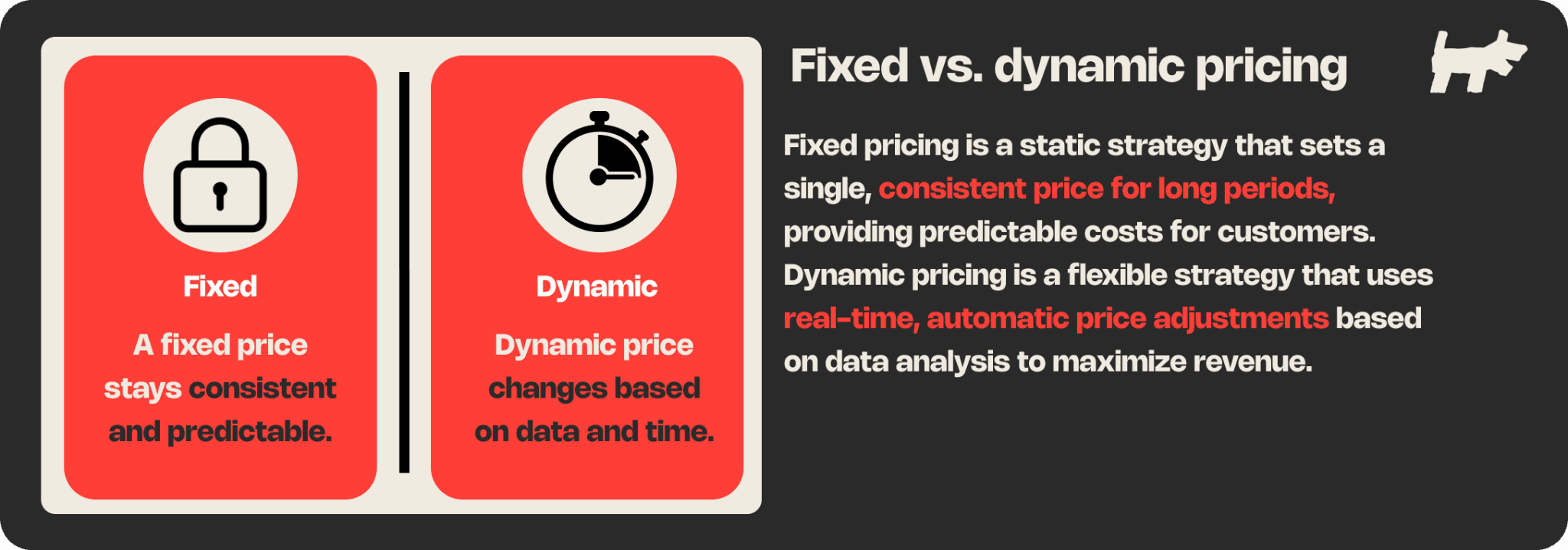
Dynamic pricing means selling the same product at different prices depending on current market conditions, competitor pricing, demand levels, time of day, season, or stock levels. It's also called real-time pricing, surge pricing, or time-based pricing depending on the context.
The mechanism under the hood is algorithmic: machine learning models continuously ingest market data and adjust prices within rules you set. The key word is "rules". You define the floor, the ceiling, the conditions, and the strategy. The tool executes.
What are the 5 dynamic pricing models?
Segmented pricing offers different price points to different customer segments for the same product. It's used when the perceived value of a product differs meaningfully across buyer groups, which it almost always does. SaaS businesses use this constantly: startup pricing, SME pricing, enterprise pricing.
Time-based pricing adjusts prices based on when a purchase happens. Night tariffs for taxis, early-bird event tickets, end-of-season discounts to clear stock. The logic is simple: price is a lever to move demand from peak moments to off-peak ones, or vice versa.
Market condition-based pricing responds to external supply and demand changes. The pandemic-era toilet paper surge is a vivid example of this playing out in the extreme. But it applies in subtler ways every day: Google Ads keyword prices spike during Christmas because demand for advertising rises.
Peak pricing extracts higher revenue during predictable high-demand windows. Airbnb hosts do this automatically. Airline pricing operates on the same principle. The last seat on a flight to Bali in August costs 4 to 8 times more than the first seat sold six months earlier. The same product sells at a wildly different price.
Penetration pricing temporarily undercuts the market to acquire customers and build market share, with the intention of raising prices once a sufficient base is established. Uber Eats used this aggressively in Belgium during the pandemic: 50% off the first five orders for six consecutive months to pull customers away from Deliveroo. It works, but the question is whether your margins can absorb the period of underpricing.
What are the advantages and risks?
The main advantages of dynamic pricing are:
Market visibility: tracking competitor prices continuously gives you a real-time map of where you sit in the market.
Customer intelligence: watching how demand responds to price changes tells you the minimum and maximum price your customers will accept, and where the elasticity cliff is.
Revenue optimisation: capturing higher prices during peak demand and clearing stock efficiently during low demand periods compounds into meaningful margin improvement over time.
The risks are real but manageable. Customer trust erodes if price swings are too large or too frequent. In 2013, during a New York blizzard, Uber prices jumped to 8x. The backlash was large enough that Uber introduced surge price caps. The fix is setting explicit rules on maximum price variance so your customers never experience a shock they consider unfair.
The second risk is triggering a price war. If a competitor responds to your price cuts with deeper price cuts, and you respond in kind, margins across the whole category compress. Think carefully before setting rules that automatically match the lowest price in the market, that race ends badly for everyone.
How do you implement dynamic pricing in 5 steps?
Step 1: Define your commercial objective. Do you want to maximise revenue, grow market share, clear old stock, or defend against a new competitor? Your objective determines which pricing model to deploy. Without a clear objective, the tool optimises for nothing.
Step 2: Build your pricing strategy. Map the objective to a model. If you're entering a new market, penetration pricing makes sense. If you have predictable seasonal demand peaks, peak pricing is the play. If you serve meaningfully different customer segments, segmented pricing unlocks margin.
Step 3: Choose your pricing method. The three most common:
Competitor-based: adjust your prices relative to specific competitors
Value-based: price based on what customers believe the product is worth, not what it costs to make
Cost-plus: production cost plus a fixed margin
These can be combined. Many businesses run competitor-based rules on their top 20% of SKUs by volume, and value-based pricing on the rest.
Step 4: Set your pricing rules. This is where strategy becomes execution. Example: "For spring collection items with stock under 5 units, match the lowest price of Competitor A or B, but never go below cost plus 15%." Tools like Prisync, Omnia, Price2spy, and Priceedge let you set these rules and automate execution.
Step 5: Test, monitor, and iterate. Run the first set of rules for 30 days. Check whether the pricing engine is behaving as intended. Measure against your objective. Then adjust. Dynamic pricing is not a set-and-forget system, it's a continuous loop of rules, results, and refinement.
Dynamic pricing is available to everyone
Dynamic pricing is no longer a capability reserved for Amazon-scale operations. The tooling is accessible, the competitive advantage is real, and the first movers in most B2C and e-commerce categories are already pulling ahead. The strategy, not the software, is what determines whether it works.