Why the model you pick changes where your money goes
When a customer converts, they've usually touched your brand several times. A LinkedIn post, a Google search, a retargeting ad, an email. Every one of those interactions contributed something.
Attribution models decide how to split the conversion credit across those touchpoints. The model you use determines which channels look like they're performing, which look like they're underperforming, and where your next euro of budget lands.
This isn't a subtle effect. Switching from last-click to a multi-touch model can completely flip which channels appear to be carrying the business. A paid social campaign that looks like it's wasting money under last-click might be the channel that introduces 60% of your customers to the brand.
Most businesses haven't made this choice deliberately. They're running whatever their ad platform defaulted to.
The 6 attribution models, plainly explained
Last-click attribution
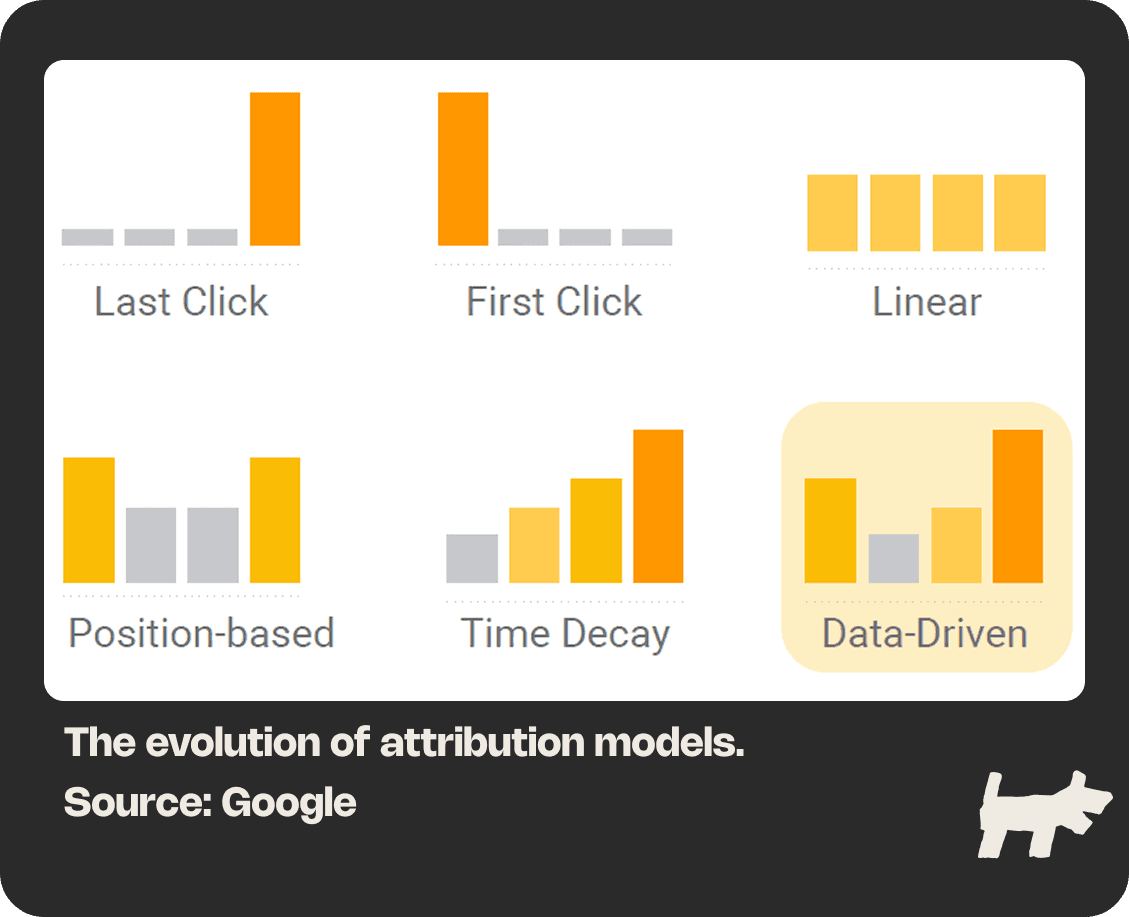
All the credit goes to the final touchpoint before conversion. If a customer found you through a YouTube ad three weeks ago, read two blog posts, and then clicked an email to buy, the email gets 100% of the credit.
This is the default in most platforms. It's clean and easy to report on. It's also systematically wrong for any business with more than one touchpoint in their customer journey.
Last-click starves your awareness channels. Over time, teams running purely on last-click data defund their top-of-funnel spend, performance stagnates, and nobody can explain why the pipeline dried up.
First-click attribution
All the credit goes to the first touchpoint. Useful specifically when you're trying to understand which channels are best at introducing new customers to your brand.
If you run significant top-of-funnel investment (YouTube, display, paid social prospecting), first-click attribution is the right lens for evaluating that spend. Under any other model, those channels will look weak because they're rarely the last thing a customer touches before buying.
The limitation: it ignores everything that happened between discovery and decision.
Linear attribution
Credit is split equally across every touchpoint in the journey. A 5-step customer journey means each touchpoint gets 20%.
It sounds fair. The problem is that equal credit makes optimization harder, not easier. You can't identify which touchpoints are genuinely influencing the decision when every interaction is treated identically, whether it was a 3-second ad impression or a 20-minute demo.
Use linear when your goal is a broad picture of channel contribution, not when you're trying to cut spending or identify what's working.
Time decay attribution
Touchpoints closer to the conversion receive more credit than earlier ones. An interaction two days before purchase gets significantly more weight than one three weeks prior.
This model reflects how short sales cycles actually work: the closer to the decision, the more relevant the interaction. For e-commerce with quick consideration phases, it's a reasonable fit.
For B2B with 6 to 12 week sales cycles, time decay systematically undervalues the content, campaigns, and calls that started the conversation. The email that first got a prospect's attention might get almost no credit because it happened eight weeks ago.
Position-based attribution (U-shaped)
40% of the credit goes to the first touchpoint, 40% to the last, and the remaining 20% is split across the middle interactions.
This is the pragmatic middle ground. It recognizes two things that are usually true: first, that the channel that introduced the customer matters; and second, that the final touchpoint that closed the deal matters. Everything in between gets acknowledged without being overweighted.
For most businesses that haven't yet built the data volume for a machine learning model, position-based is the most defensible starting point. It doesn't require large datasets, it's explainable to a CFO, and it doesn't ignore either end of the funnel.
Data-driven attribution
Instead of following a fixed rule, data-driven attribution uses machine learning to analyze your actual conversion paths and assign credit based on which touchpoints statistically increased the probability of conversion.
In theory, it's the most accurate model. In practice, it has a hard requirement: it needs a large volume of conversions to produce reliable weights. Google's data-driven model in GA4, for instance, requires a minimum number of conversions before the algorithm produces results. Accounts that don't hit that threshold fall back to another model automatically.
If your business has the volume, data-driven attribution is worth using. If you don't, you're getting a false sense of precision from an algorithm that hasn't seen enough data to be reliable.
Which model fits your situation
There's no universally correct model. The right choice depends on your sales cycle, your data volume, and what decision you're trying to make.
Use this as a starting point:
Short sales cycle (e-commerce, impulse purchase): Time decay or last-click are useful. Customers typically convert within days. Recency is correlated with influence.
Longer sales cycle (SaaS, B2B, high-ticket): Position-based or linear. You need to see the full path, not just the final touch.
Top-of-funnel investment decision: First-click. If you're deciding whether to keep spending on awareness channels, evaluate them on what they're actually designed to do: introduce customers.
You have high conversion volume and technical resource: Data-driven. Let the algorithm work. But verify you have the volume to support it before trusting the outputs.
You're just starting to think about this: Position-based. It's explainable, balanced, and doesn't require machine learning or large datasets.
How GA4 handles the gaps your tracking misses
Even the best attribution model is only as good as the data behind it. And today, a significant share of customer interactions simply aren't being tracked: ad blockers, cookie opt-outs, and consent banners all create holes in the picture.
Google Analytics 4 addresses this differently from its predecessor. GA4 uses machine learning to model the behavior it can't directly observe, filling gaps with statistically inferred data rather than leaving them blank.
This matters for attribution because missing touchpoints distort credit allocation. If an ad impression isn't tracked because a user had an ad blocker, that interaction drops out of the attribution path entirely. GA4's modeled data puts something back in its place.
How to actually switch models without breaking your reporting
Changing your attribution model mid-flight will change your historical performance numbers. Before you touch anything:
Export your current channel performance data as a benchmark. You'll want to compare before and after.
Run your new model in parallel for 4 to 6 weeks before making budget decisions based on it. Most platforms let you compare models in a report view without changing what's applied.
Check your conversion volume before enabling data-driven. If your account is below threshold, pick position-based first and revisit data-driven in 6 months.
Align with your media team before you switch. A shift in attributed performance will look like a channel is suddenly over- or underperforming. If your team doesn't know the model changed, they'll optimize against the wrong signal.
Tell your CFO what you changed and why. Attribution model changes explain a lot of sudden swings in reported ROAS or pipeline numbers. Get ahead of the question.
Pick a model that fits your sales cycle
Running on last-click by default means you've made that decision without making it.
Pick a model that fits your sales cycle. Use GA4's comparison tools to understand what changes when you switch. And revisit the model when your data volume or channel mix changes significantly.