What a growth team actually does
A growth team is a small, cross-functional squad drawn from marketing, sales, product, and engineering. Its job is to run rapid experiments across channels and touchpoints to find the fastest path to growth on whichever metric matters most.
What separates a growth team from a regular marketing team is the Pirate Funnel. Traditional marketing optimises for the top of that funnel. Growth teams work across all six stages simultaneously.
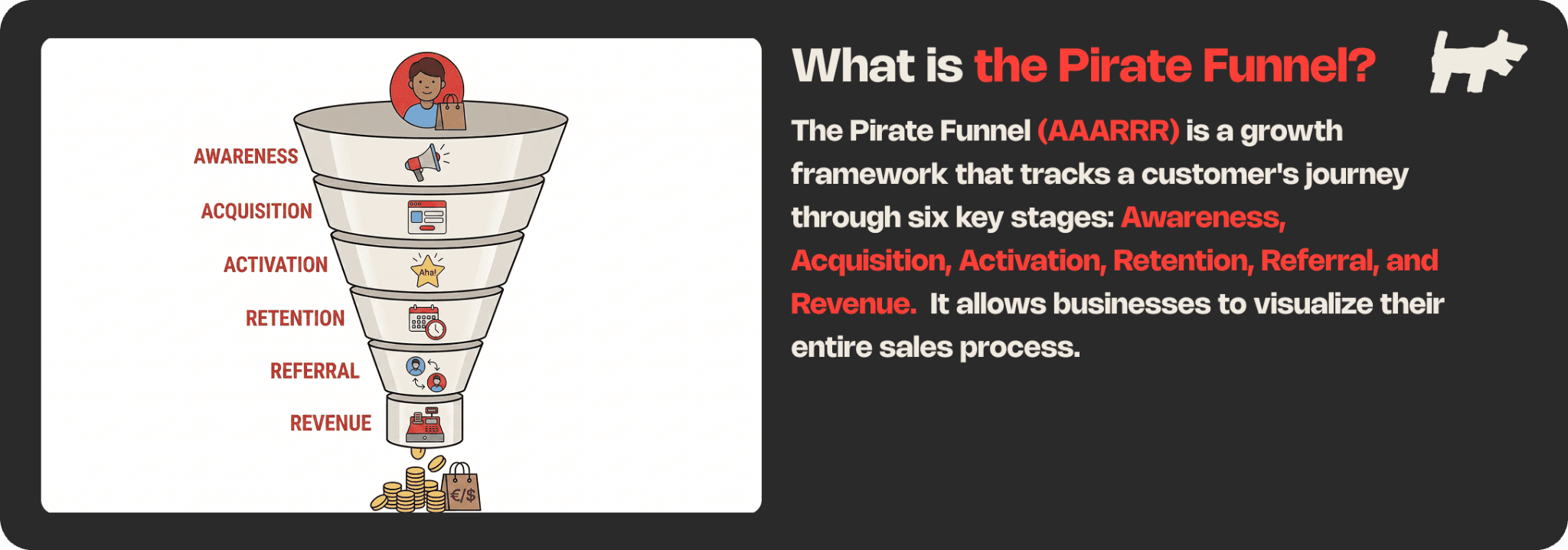
A concrete example: a salesperson notices that leads consistently say they couldn't find the product catalogue. A growth team would turn that into a testable hypothesis: an exit-intent popup offering the catalogue in exchange for an email address. Now sales gets a warm lead who has already self-qualified by downloading the catalogue. The conversion rate goes up. The experiment takes two days to build and two weeks to measure.
That is growth marketing in practice. Not a campaign. A loop.
The 5 roles you need on a growth team
Growth teams don't need 15 people. They need 5 profiles:
A flexible manager with authority to approve experiments without a two-week sign-off chain. If launching a test takes longer than the test itself, the team dies.
A project manager who owns the sprint backlog, chases deliverables, and keeps experiments from stalling. This doesn't have to be a separate hire: it can be the marketer or the sales lead, as long as someone explicitly owns the process.
A creative person who can produce copy and visuals fast enough to keep up with the experiment cadence. A/B testing 3 ad variants a week is normal. This person needs to be comfortable moving at that pace.
A technical person who understands the martech stack: what tools are connected to what, where data is being collected, what can be automated. Missing this role is the single most common reason growth experiments stall in execution.
A salesperson who brings the customer's voice into every experiment. Sales hears objections, hesitations, and buying signals daily. That intelligence is the raw material for good growth hypotheses.
All members should be T-shaped: broad enough to cover for each other, deep enough to own their domain.
The 4 problems that kill growth teams
1. Prioritisation
Growth experiments end up being "something the marketing team does between their actual tasks." If experimentation is not protected time on the calendar, it will always lose to the quarterly campaign.
2. Failure tolerance
Management expects immediate results. Growth doesn't work that way. Most experiments fail and that is the point. A failed experiment that tells you your audience doesn't respond to price-led messaging is worth more than a campaign run on a hunch. Set the expectation upfront: you are buying learning, not guaranteeing conversion.
3. Silo persistence
Even when people are assigned to a growth team, they often still act as representatives of their department rather than members of the squad. A designated growth manager who runs the weekly sync and keeps information flowing across the group is the fix.
4. Loss of speed
Rapid experimentation only works if the loop is fast: build, launch, measure, iterate. If getting one experiment live takes three weeks of approvals, the team loses momentum and leadership loses confidence. Without speed, there is no growth team, just a committee.
How to start your first growth team in 90 days
Start small. One squad. One experiment cycle. Three months.
The team can be as lean as 5 people: one marketer, one salesperson, one technical person, one customer success person, and one person from management who can approve experiments without escalation.
Run your first sprint for 4 weeks. Pick one metric to move, like conversion rate, lead quality score or churn rate. Generate 5 hypotheses. Run the 2 most promising. Report the results to the wider organisation at the end of the sprint.
This last step matters more than the results themselves. Presenting experiments to the rest of the company activates the culture of experimentation. It signals that trying new things is rewarded, not punished.
Break the silos down
The growth team model works because it breaks the silos that slow every large organisation down. The people you need already exist inside your business. What they need is protected time, a clear process, and permission to fail fast.