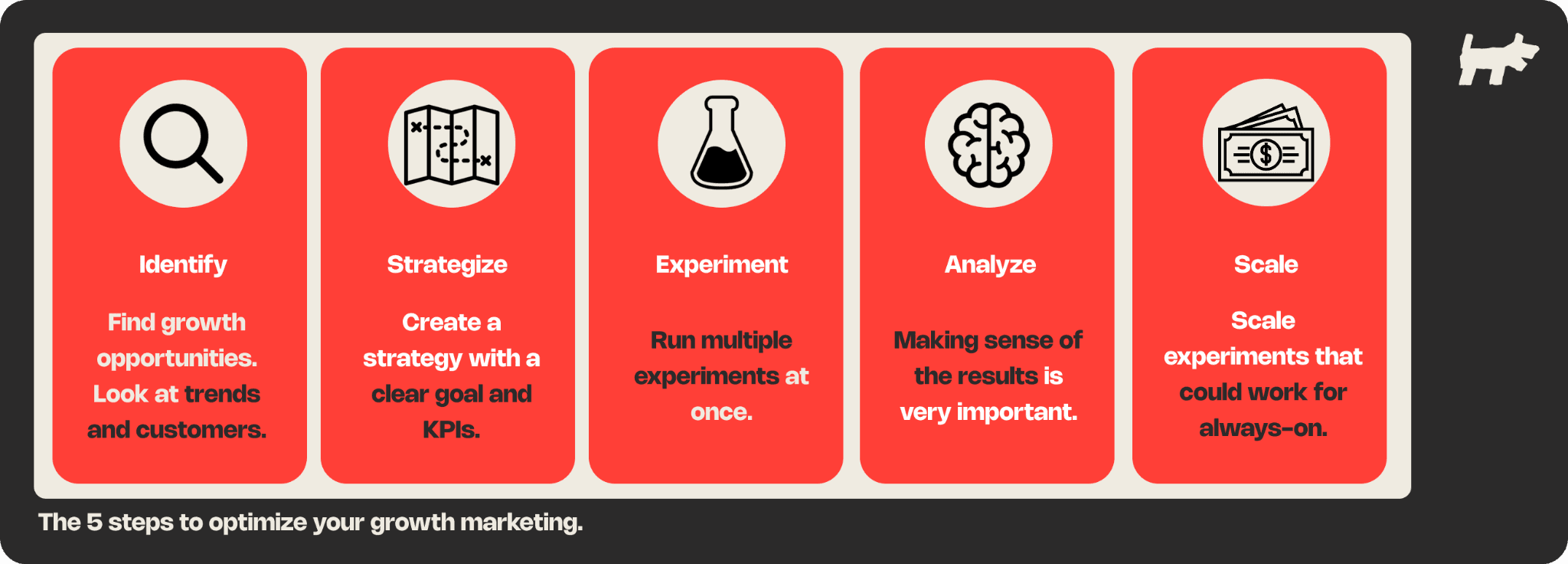
Step 1: Identify growth opportunities
Growth opportunities don't announce themselves. You find them by asking sharper questions about your market, your customers, and your competition.
Four places to look:
Market research. Surveys, online analytics, and customer interviews identify trends and behavioral patterns. The goal is to understand what your customers are trying to do, not what you think they want.
Competitive analysis. Check competitors' top keywords through tools like Ahrefs. Review their social ads via the Facebook Ads Library. Identify where they're investing and, more importantly, where they're not.
Internal audit. Evaluate your own product or service for gaps. Where do customers drop off? Which features drive the most retention? Your own data is often the richest source of opportunity.
Emerging trends. Stay close to industry news. Run internal sessions. At Fightclub, we do a monthly "Beer & Learn" where the team discusses new tools, findings, and trends. Institutionalising this keeps the whole team in the loop.
Once you've identified your opportunities, the gap analysis framework is a useful structure for mapping current state, target state, and the actions to close the distance.
Step 2: Build a growth strategy
A growth strategy is not a list of tactics. It's a plan that connects a clear goal to the actions most likely to achieve it. Start with a high-value objective that justifies long-term investment: something ambitious enough to still be meaningful in 12 months, not just this quarter.
A complete growth strategy covers:
Clear KPIs. Define customer acquisition cost (CAC), customer lifetime value (CLV), and ROI targets before you launch anything. Metrics set after the campaign are decorations, not tools.
Buyer personas and channel selection. Know who you're targeting and where they actually are. Our State of Growth survey found that most B2B businesses default to LinkedIn, while B2C businesses significantly underuse TikTok. Don't let habit decide your channel mix.
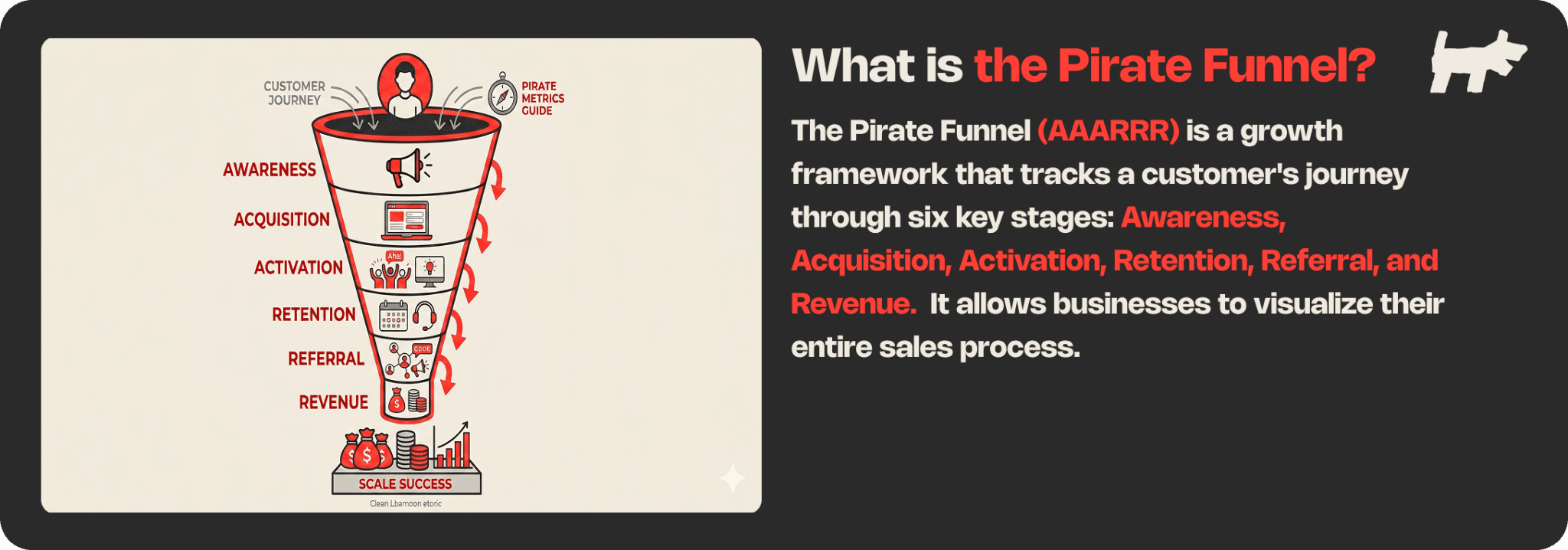
Customer journey optimization. Test different interfaces, reduce friction, and improve conversion rates across the funnel. Look beyond acquisition. Explore the Revenue and Referral stages of the Pirate Funnel.
Community engagement. Involving customers in the brand (through feedback loops, user communities, or co-creation) builds retention that paid acquisition can't replicate.
For a deeper look at how growth marketing differs from traditional growth hacking, see: growth marketing vs growth hacking.
Step 3: Embrace experimentation
The typical agency model: brainstorm, align on one idea, commit a large budget, wait for results. In growth marketing, this is how you lose big. Instead, we run experiments.
From our State of Growth data: 1 to 10 experiments per month is the sweet spot. 87% of mature marketing organisations operate in this range. It's enough to generate meaningful data without overloading the team or diluting execution quality.
Running multiple experiments simultaneously also lets you compare tactics (different messages, channels, and targeting strategies) and identify what actually works for your specific audience rather than what the industry thinks should work.
See our guide on 25 proven growth hacking examples for concrete experiment ideas you can adapt.
Step 4: Collect and act on data
40% of businesses in our State of Growth survey identified data collection and analysis as their biggest challenge: not running experiments, but making sense of the results.
Five practices that make data analysis usable rather than overwhelming:
Define goals before collecting data. Know what you're measuring and why. A KPI defined after the campaign tells you nothing useful.
Use the right tools. Google Analytics, Mixpanel, and HubSpot are the most commonly used. Choose based on what your team will actually use consistently, not what has the most features.
Collect relevant data only. More data is not better data. Collecting everything creates noise. Focus on the metrics that connect directly to your growth KPIs.
Analyse regularly, not just after campaigns. Weekly data reviews surface early signals that monthly reviews miss.
Take action on the findings. Data that doesn't change a decision wasn't worth collecting. If the analysis shows something isn't working, act on it within the same cycle.
If you want to understand how to connect your data to specific attribution decisions, our marketing attribution models guide is a useful companion.
Step 5: Scale what works
Not every successful experiment becomes an always-on campaign. Before scaling, ask: is this result driven by a current trend, or does it reflect stable customer behavior? Trend-driven results can be seasonal. Behavior-driven results can be permanent.
At Fightclub, we expect 5% to 10% of experiments to be promoted to always-on campaigns. That sounds low. Over 12 months of consistent experimentation, running 6 to 8 experiments per month, it produces 4 to 10 validated, scalable campaigns per year. Each of those represents a real and compounding gain in marketing performance.
For experiments that don't qualify for always-on status, define a timing strategy. A strong seasonal campaign from Q4 can be repurposed and improved for Q4 next year. Nothing is wasted if you document the learnings.
Dare to experiment
A growth process turns marketing from a series of bets into a learning system. You lose less when experiments fail. You fail small and fast. You win more when they succeed, because you know what drove the result and can invest behind it.
The teams that get the most from growth marketing aren't the ones with the biggest budgets. They're the ones that run the most consistent, well-documented experiments over the longest period of time.