What is a gap analysis?
A gap analysis is a structured planning process that maps the distance between your current business state and your desired future state, then builds a concrete action plan to close it. It is not a brainstorm. It is not a vision board. It is a diagnostic tool that produces a series of specific, measurable projects your team can run.
The benefits are straightforward:
It forces deeper thinking about what is actually holding the business back, not just what feels urgent this week.
It produces an action plan with clear steps rather than vague strategic intent.
It creates measurable checkpoints between time intervals so you can see whether the plan is working or needs adjustment.
It works as a collaborative exercise: bringing multiple strategic thinkers into the same template surfaces blind spots and creates shared ownership of the outcome.
Gap analysis sits directly upstream of strategic objectives. Once you know the gap, you know what the objectives need to close it.
The mindset before you start: honesty over optimism
A gap analysis is only as useful as it is accurate. Two failure modes kill most attempts before the template is half-filled.
Vague current-state descriptions. "We are not where we want to be on lead generation" is not a current state. "We are generating 7 sales calls per month against a target of 50" is. Specificity is what makes the gap visible and closeable.
Ambitious future states without constraints. The future state is not a wish list. It needs to account for your actual capacity, budget, and timeline. Accuracy matters more than ambition here. An achievable gap plan executed well beats an inspirational one that never leaves the whiteboard.
Step 1: define your focus areas
The first step is choosing which areas of the business the gap analysis will cover. Pick a maximum of 4. More than that and the exercise spreads too thin to produce actionable projects.
The most common focus areas we see across client engagements:
Lead generation
Marketing and sales team capability
Martech stack
Customer support and success
Financial growth
Culture and employee happiness
Innovation
Sales development
Choose the areas where the gap between today and your desired state is widest, or where closing the gap would have the highest downstream impact. If you are unsure where to start, a growth marketing audit across your acquisition channels is often the fastest way to identify where the real constraints sit.
Step 2: write your future state first
Most frameworks start with the current state. We do not. Writing the future state first produces a better current-state assessment. Here is why.
If you assess your current state in isolation, you end up describing operations rather than gaps. But if you define where you want to be first, you immediately start evaluating your current state through the lens of what is missing. The gap becomes visible rather than implied.
The future state does not need to be granular at this stage. It is a high-level intention, not a KPI (those come in step 4). Two examples:
Lead generation: "Increase the number of qualified leads we generate by 100% by the end of the year."
Martech stack: "Automate most of the daily, low-expertise work in the sales and marketing team so they spend more time on high-value activity."
Notice what these statements share: they name a direction and a rough outcome without prescribing the method. The method comes in step 5.
Step 3: write an honest current-state summary
Now, with your future state in front of you, write a single concise sentence that describes where you actually are today. Not where you hope to be. Not where you were six months ago. Where you are right now, relative to the future state you just wrote.
Two examples, matched to the future states above:
Lead generation: "We have a strong product but no meaningful presence on social or search, so prospects do not find us before they find a competitor."
Martech stack: "The marketing team is not tool-savvy. We use HubSpot CRM and Zoom. Roughly 10% of daily work is automated. The team spends significant time on tasks that could be handled by a basic workflow."
The current state does not need to be long. It needs to be specific enough that two people reading it would agree on what it means. Vague current states produce vague action plans. If you find yourself writing in generalities, push harder: name the number, name the tool, name the team that is underperforming.
Step 4: attach leading and lagging KPIs to each focus area
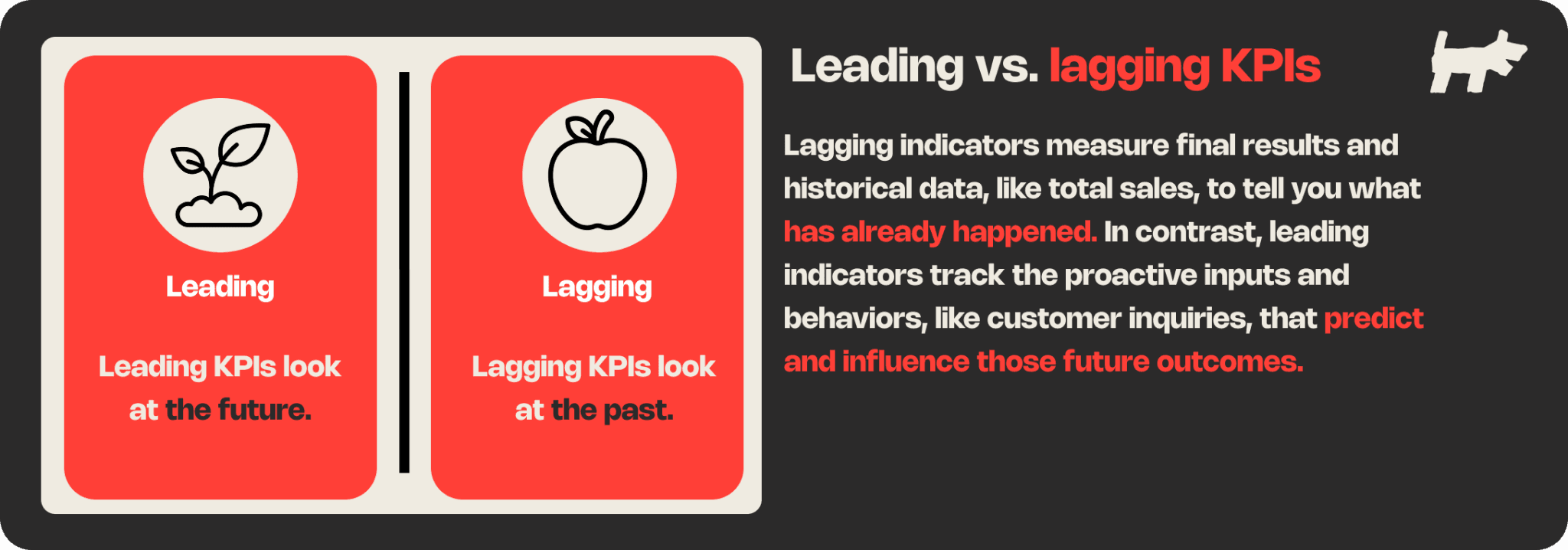
This is where the gap becomes measurable. For each focus area, you need two types of KPI: one that tells you whether you are on track (leading), and one that tells you where you currently stand (lagging). If you can only measure one, measure the leading indicator. It is the one you can actually act on.
Leading indicators describe future-oriented inputs: the actions you are taking that should produce the result. They are dynamic and within your control.
Lagging indicators describe current or historical performance: the result as it stands right now. They are fixed and not changeable, but they give you the baseline to measure progress against.
Using the lead generation example:
Leading KPI: "Generate at least 50 qualified sales calls per quarter through inbound and outbound campaigns."
Lagging KPI: "We are currently booking 7 sales calls per month, all from direct referrals. Zero from inbound."
Using the martech stack example:
Leading KPI: "Automate 50% of the daily, no-expertise-required work in the sales and marketing team using new tooling within 6 months."
Lagging KPI: "Current automation covers roughly 10% of daily work. The team manually handles email sequences, reporting, and basic CRM updates."
Pick KPIs you already have a reference point for. A KPI you cannot currently measure tells you nothing about the gap and nothing about progress. If a metric matters but you cannot track it yet, fixing your data infrastructure becomes a project in the action plan.
Step 5: build the action plan, 2 to 5 projects per focus area
This is the step most gap analysis exercises skip or do badly. The future state and KPIs are clear, but the action plan stays abstract. An abstract action plan is just an optimistic description of the gap. The point is to break the gap into a series of concrete, sequenced projects each with a clear hypothesis, a timeline, and a way to measure whether it worked.
The formula: 2 to 5 projects per focus area. More than 5 and you lose focus. Fewer than 2 and you are probably underselling the complexity of the gap.
Using the lead generation focus area (target: 100% increase in qualified leads):
Website and platform optimization. Install exit-intent popups, opt-in forms, live chat, and WhatsApp. Audit and improve the UI and UX on key landing pages to reduce drop-off.
Growth marketing canvas session. Use the growth marketing canvas to identify the 15 highest-potential experiments across acquisition channels.
Rapid experimentation programme. Run the top experiments from the canvas session with individual sub-project sheets tracking hypothesis, duration, and results.
Each project needs 3 things to be useful: a clear owner, a start and end date, and a measurable outcome. Without those, it is a suggestion rather than a commitment. For the experimentation layer, our growth hacking examples post covers the rapid test-and-learn approach that sits beneath most of these projects.
A gap without a project owner is just a problem with a name
The 5-step framework is straightforward to run. What makes the difference between a gap analysis that changes something and one that collects dust is ownership. Every project in the action plan needs a named person responsible for it. Not a team. Not a department. A person.
Once the template is filled, the next step is turning the projects into strategic objectives with quarterly deadlines, and assigning those objectives to leads who report on them. The gap analysis gives you the map. The objectives and the owners are what move the organisation toward it.