#1 Target audience: use filters to find the right buyer, not just a big audience
The most common mistake in real estate Facebook advertising is targeting too broadly. A wide audience with an average CPM of €5 sounds efficient until you realise half your impressions are going to renters with no buying intent. Precision targeting pays for itself. Here are the filters worth using.
Location.
Start with your actual sales data. Look at where buyers in the last 2 years came from, and build your radius or zip code targeting around that. If you do not have that data yet, use a 15 to 25 km radius around your listings as a starting point and refine from there.
Age and demographics.
First-time buyers skew 28 to 40. Move-up buyers skew 38 to 55. Luxury buyers are spread more broadly but income is a better filter than age at that end of the market. Narrowing by age alone can cut wasted spend by 20% or more on most campaigns we run.
Income.
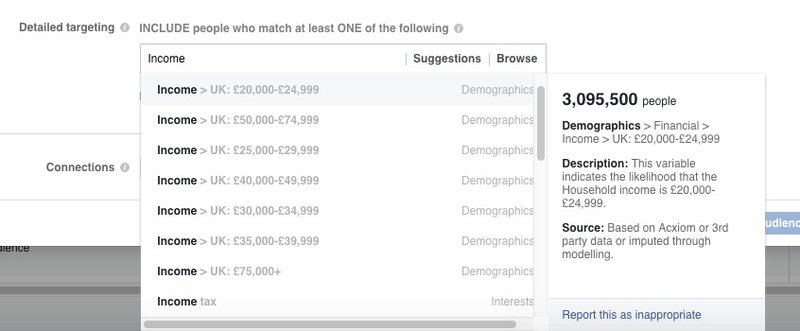
This is one of the most underused filters in real estate advertising. Facebook lets you target by household income bracket under Detailed Targeting. Match your property price points to the income range that can realistically afford them. A luxury villa targeting a €25,000 household income bracket is wasted budget.
Home ownership status.
Facebook lets you filter by first-time homebuyer, current owner, or renter. These are very different audiences with different messages. A first-time buyer needs reassurance and guidance. A current owner looking to move up needs to see aspirational listings. Do not send the same ad to both.
Behavioral targeting: "likely to move".
Under Detailed Targeting, Behaviors, Residential Profiles, you can target people Facebook has identified as likely to move based on their activity. This is not a replacement for the above filters but it layers in real intent signals. Worth testing.
Lookalike audiences.
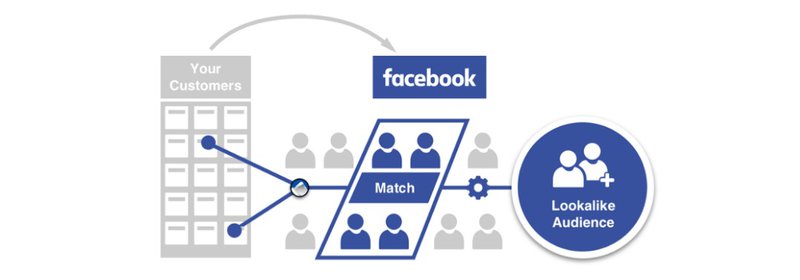
If you have a list of past buyers or qualified leads, upload it to Facebook and build a lookalike audience. A 1% lookalike off a clean CRM list of 200 past buyers is typically the highest-converting audience segment we see in real estate campaigns. It is the closest thing to automated referrals.
#2 Use carousel ads to replicate how buyers browse properties
Before carousel ads, a real estate Facebook ad meant one photo and a link. Carousel format changes that. Each card in a carousel can show a different room, angle, or property, which mirrors how buyers actually browse on property websites. They want to see the kitchen, the garden, the street, the bedroom. Give them that without leaving Facebook.
Two approaches work well:
Single property carousel: each card shows a different room or feature of the same property. Good for high-value listings where you want to hold attention and tell a visual story.
Multi-property carousel: each card shows a different listing. Good for agencies with multiple properties at similar price points. Lets the buyer self-select.
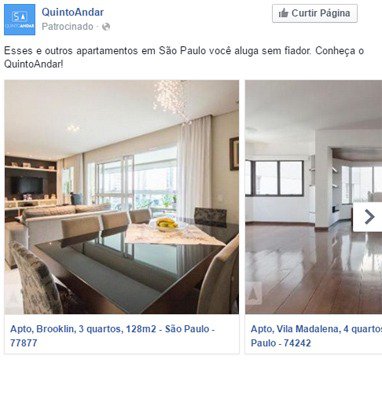
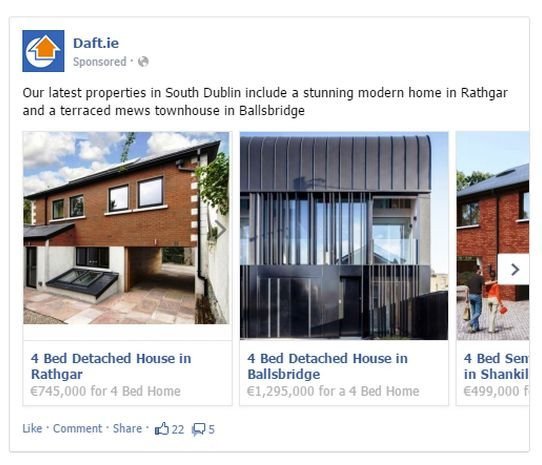
Add a text overlay to each card with the key specs (price, m2, location, number of bedrooms) so buyers can qualify themselves before clicking. Pair each card with a short description line. See how dynamic pricing logic can inform which listings to lead with when you are running multiple properties at different price points.
#3 Use video ads to build trust and show what photos hide
Most real estate buyers have been burned by photos. Wide-angle lenses make 40m2 apartments look like lofts. Filters make north-facing rooms look bright. Video is harder to fake, and buyers know it. That is exactly why it works.
A 60 to 90 second walkthrough video does three things a photo cannot:
It shows scale and flow between rooms accurately.
It captures the neighbourhood, the street, the light at a specific time of day.
It puts the agent on camera, which builds personal trust before any direct contact.
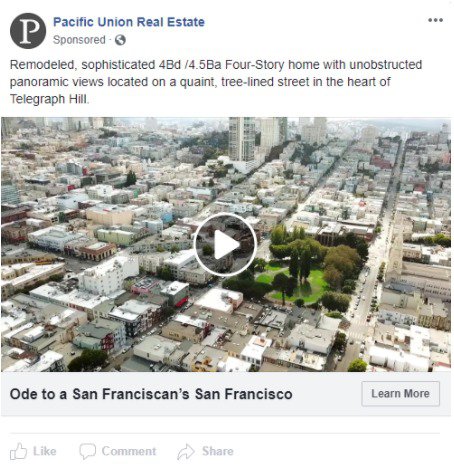
Most agents avoid video because it feels effortful. That gap is your advantage. Fewer than 15% of real estate Facebook ads use video, which means showing up with a well-shot walkthrough immediately differentiates you. A smartphone in good light with a stabiliser is enough to start. You do not need a production crew for the first test.
For a broader view of how video fits into a content-led growth marketing strategy, the principle is the same: trust is built through consistency and credibility, not production budget.
#4 Write ad copy that informs, not impresses
Real estate ad copy has one job: give buyers the information they need to decide whether to click. They are not looking for clever writing. They are looking for price, size, location, and availability. Give them that, clearly and quickly.
The formula that works:
Lead with the single most compelling fact (price, m2, or a specific feature like "private garden" or "new build").
Follow with the 3 to 4 specs a buyer needs to qualify themselves: bedrooms, bathrooms, m2, price range, neighbourhood.
End with a single clear CTA: "Book a viewing" or "See all photos”.
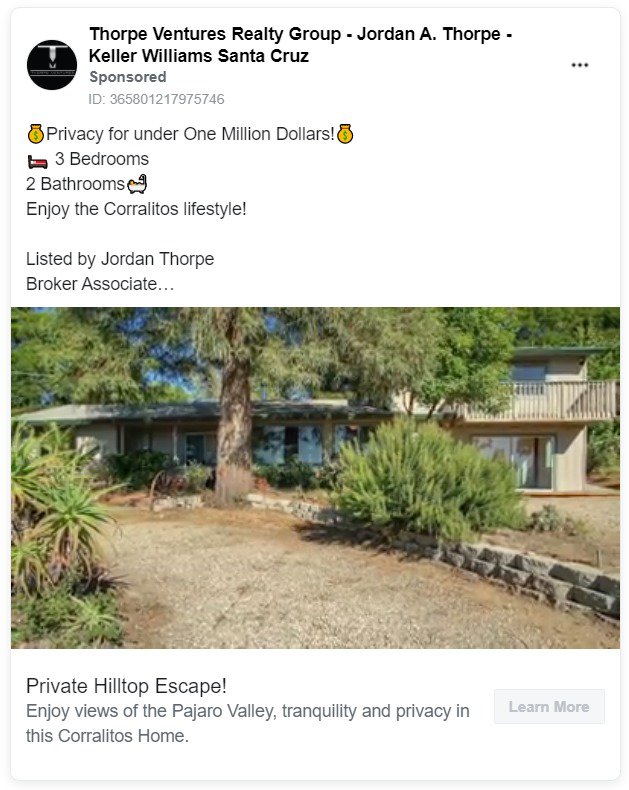
What to avoid: long paragraphs, emotional language ("your dream home awaits"), vague descriptors ("spacious", "charming", "cosy"). Specific numbers outperform adjectives every time. "148m2" is more persuasive than "spacious." "€349,000" does more qualifying work than "competitively priced."
The same principle applies to ad copy across channels. For more on how copy decisions affect conversion in paid social, see our piece on LinkedIn Thought Leader Ads.
#5 Invest in professional photography
Facebook ads are a visual medium. The image is seen before the copy, before the headline, before anything else. In real estate, the photo is the ad. Everything else supports it.
Professional real estate photography costs between €150 and €400 per shoot depending on property size. Against an average commission on a Belgian property sale, that is less than 0.1% of the transaction value. It is the highest-ROI line item in your marketing budget and the one most agents skip.
What a professional shoot gives you that a smartphone does not:
Consistent exposure and white balance across every room, so interiors look accurate rather than dark or blown out.
Composition that makes rooms feel their actual size, not artificially wide or cramped.
A selection of 20 to 30 edited images you can use across Facebook ads, carousel formats, and your website listing simultaneously.

Good photography also changes your conversion rate downstream. Buyers who click on a well-photographed ad have higher intent than those who click out of curiosity. They have already seen the property at its best and they still want to know more.
#6 Use text overlays to add a second information layer
Facebook allows text to cover up to 20% of the ad image. That 20% is prime real estate. The attention sequence on a Facebook ad is: image first, overlay second, body copy third. Most buyers make their "worth clicking" decision before they reach the body copy. The overlay is your chance to communicate one more piece of qualifying information while their eye is still on the image.
Use the overlay for the single most attention-grabbing spec:
"From €295,000" on a new development ad.
"148m2 | 3 bed | Uccle" on a single-property carousel.
"3D tour available" if that is a differentiator in your market.
"Open house: Saturday 14 June" if you are driving event attendance.
Keep the overlay short (5 words or fewer), high contrast, and placed in a corner that does not obscure the strongest visual element of the photo. A text overlay that covers the property facade or the main living area defeats its own purpose. For how text and visual hierarchy work together in paid social creative, the same principles apply to hyper-personalization in ad creative: the message the buyer sees first shapes everything that follows.
A dedicated system
These 6 tips work as a system. Precise targeting sends your ad to the right person. Professional photography stops the scroll. Video builds trust. Carousel format holds attention. Descriptive copy qualifies intent. The text overlay closes the loop on the visual. Remove any one of them and the others work harder to compensate.