What hyper-personalization is and where it came from
Personalization in marketing is not new. In 1974, IBM ran a direct mail campaign that segmented its audience into 7 distinct groups and sent each a different message tailored to their profile. The campaign achieved an 80% response rate and generated over $13 million in revenue. The three principles IBM used (segmentation, targeting based on behavioral timing and personalizing the message to the identified need) are still the foundation of every effective personalization strategy today.
What has changed is the scale and speed. In 1974, segmentation was manual and the data was sparse. Today, ecommerce businesses have access to real-time behavioral data, first-party cookies, CRM histories, purchase sequences, and AI models that can predict what a customer is likely to buy next before they know themselves.
Hyper-personalization is the current state of that progression: using real-time data and automated decisioning to deliver a personalized experience to every individual customer, not just to broad segments. The goal is for every touchpoint to feel like it was designed for that specific person.
The data problem: you have it, but it is scattered
Most businesses that struggle with personalization do not have a data shortage. They have a data organisation problem. Customer data sits in silos: your CRM holds purchase history, your customer service team holds complaint and query data, your analytics platform holds behavioral data, and your email platform holds engagement data. Each silo is useful on its own. None of them is useful without the others.
Structuring your data into a single customer view is the prerequisite for hyper-personalization. You cannot segment effectively if you cannot see the whole customer. You cannot personalize product recommendations if purchase history and browsing behavior are in separate systems with no connection between them.
The practical starting point is not a new tool. It is a data audit: map where your customer data lives, identify what is in each system, and determine what connections are missing. Once you can see the gaps, you can close them.
This is the same principle that underpins data-driven marketing more broadly: the quality of your decisions is a direct function of the quality and accessibility of your data.
The 4 segmentation types that make personalization precise
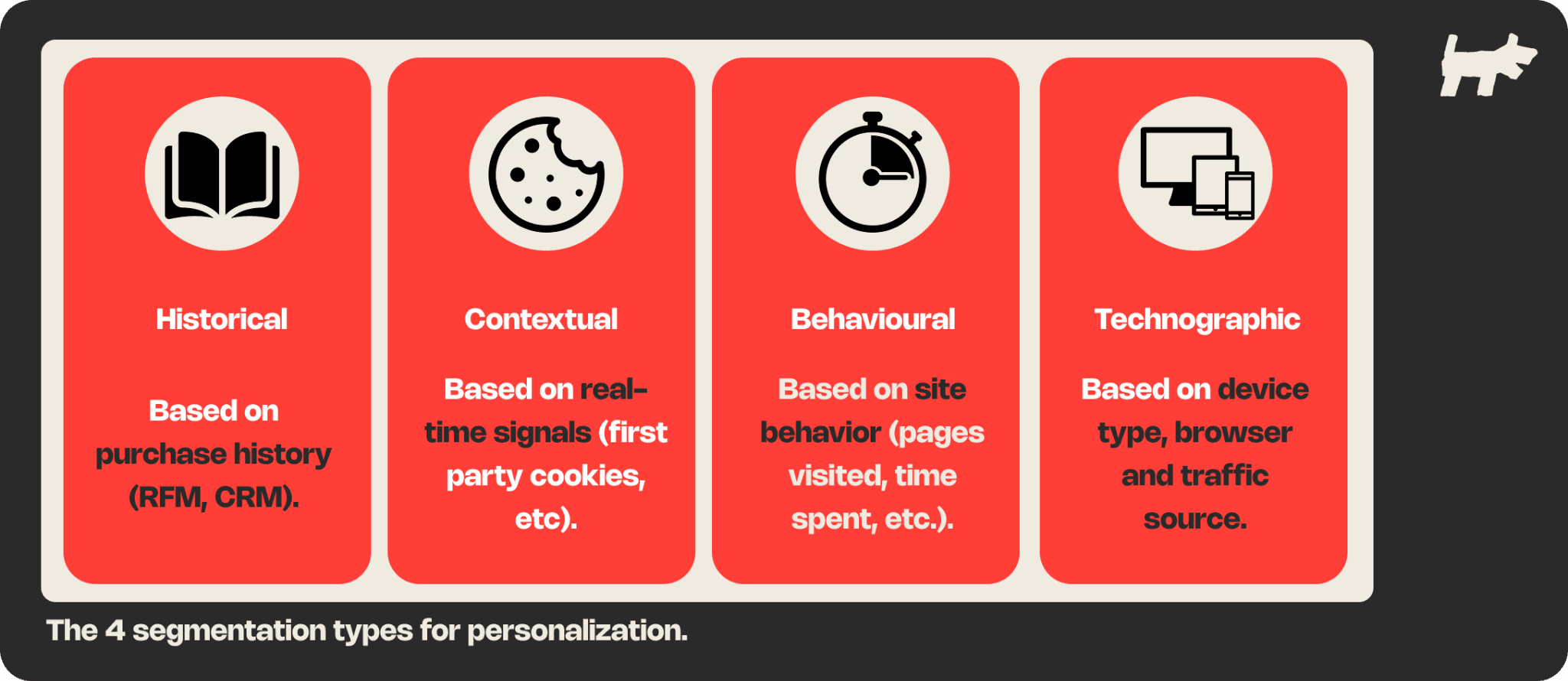
Segmentation is what converts raw data into actionable personalization. The more granular your segments, the more relevant the experience you can build for each one. There are 4 segmentation types worth implementing, each using different data sources.
Historical segmentation
Based on purchase history, CRM attributes, and RFM analysis (Recency, Frequency, Monetary value). RFM is particularly useful because it combines three dimensions: how recently a customer bought, how often they buy, and how much they spend. A high-RFM customer who has not purchased in 60 days is a very different re-engagement candidate from a low-RFM customer who last bought 90 days ago. Treating them identically wastes budget and erodes trust.
Contextual segmentation
Based on real-time signals: first-party cookies, on-site search keywords, and location data. A customer in Antwerp searching for "waterproof jackets" on a rainy Tuesday afternoon is telling you exactly what they need. Serving them a homepage hero image of summer dresses is the opposite of personalization. Contextual segmentation closes that gap: it adapts the experience to where the customer is, what the weather is doing, and what they typed into your search bar 10 seconds ago.
Behavioral segmentation
Based on on-site behavior: pages visited, product categories browsed, time spent, items added to cart and removed, content engaged with. Behavioral data is the strongest signal of near-term intent because it reflects what the customer is actively considering right now, not what they bought six months ago. A visitor who has viewed the same product page 3 times in 2 days is not the same as someone who landed there once from an ad.
Technographic segmentation
Based on device type, browser, operating system and traffic source. A customer who arrives via a TikTok ad has a different expectation and attention span than one who comes from a Google search for a specific product name. Traffic source is one of the most underused personalization signals in ecommerce. Audiences from paid social want visual impact and emotional resonance. Audiences from branded search want confirmation and a fast path to purchase. Serving both the same landing page is leaving conversion rate on the table.
Personalization strategies that move revenue
Product recommendations
Recommendations based on past purchases work particularly well for consumable or replacement products: skincare, supplements, pet food, coffee. If a customer bought a 30-day supply of something 28 days ago, a recommendation arriving on day 26 is not marketing, it is service. The timing is the personalization.
For non-replenishment products, recommendations based on category browsing and complementary items are the most effective. A customer who buys a camera is likely to need a bag, a memory card, and a cleaning kit. A static "customers also bought" row is better than nothing. A personalized recommendation triggered by what they specifically viewed and what their purchase history suggests they are missing is significantly better.
Personalized email beyond the first name
Putting a first name in a subject line is not personalization. It is mail merge. Real email personalization adapts the content of the email: the products shown, the offer made, the timing of the send, all based on where the customer sits in their lifecycle, what they last purchased, and what they have recently browsed.
The abandoned basket sequence is the most obvious application. A customer who added 3 items to a basket, removed one, and left without purchasing is giving you a clear signal. A generic "you left something behind" email is a missed opportunity. An email that shows the 2 items still in the basket, references the category of the removed item without being intrusive, and includes social proof specific to those products performs substantially better.
For the broader email marketing infrastructure that supports this, see our post on email marketing case studies.
Emerging channels: WhatsApp and push notifications
Nine out of ten consumers say they would prefer to contact a business via messaging rather than email, according to Dimensions Data research. WhatsApp in particular is underused as a marketing channel, which currently makes it an advantage for early adopters. A WhatsApp message lands in a notification the customer will see. An email lands in a folder they may not open for three days.
For B2B applications, WhatsApp outperforms email on open rates for short, high-value messages: a follow-up after a demo, a reminder about an expiring trial, a link to a relevant piece of content based on what they discussed in a call. The channel is direct and personal by default, which means the bar for relevance is higher. A generic broadcast via WhatsApp will feel more intrusive than the same message sent by email. Match the channel to the message.
Rapid experimentation: how to build and refine your approach
Hyper-personalization is not a project you complete and ship. It is a programme you run continuously. Experimentation is the mechanism that turns a hypothesis about your audience into a proven tactic.
The approach mirrors growth marketing methodology: start with your largest customer segments, test one personalization variable at a time, measure the result, and use what you learn to break segments down further. Starting with broad segments lets you develop your testing process and tooling before the complexity increases. A business that tries to personalize for 50 micro-segments before it has proven the approach for 5 macro-segments will build expensive infrastructure on top of an unvalidated hypothesis.
What to test first, in order of impact:
Homepage hero and product listing page personalization by traffic source.
Abandoned basket sequence timing and content variation by product category.
Email send timing by purchase history segment (active buyers vs. lapsed vs. never-purchased).
Product recommendation algorithm (collaborative filtering vs. category-based vs. recently-viewed).
Channel choice per segment: who responds better to email vs. push notification vs. WhatsApp.
AI and machine learning tools can now be set up and deliver personalization results within 4 weeks. The technology barrier is lower than it was 3 years ago. The barrier that remains is organisational: getting the data structured, the segments defined, and the experimentation culture in place so that the tools have something useful to work with.
Third-party cookies and the data regulation context
Third-party cookie restrictions have been phased in progressively across browsers, and further regulation is coming. The businesses that will feel this least are the ones that have already built their personalization programmes on first-party data: data collected directly from their own customers with explicit consent.
The practical action right now is to build your first-party data assets before restrictions tighten further. Specifically:
Collect WhatsApp and SMS opt-ins now, while the channel is under-regulated and the competitive advantage is meaningful.
Audit your on-site data collection to ensure first-party behavioral data is being captured and stored correctly.
Review your email list health and consent records. A list built on clear opt-in is a data asset; one built on unclear consent is a liability.
The businesses that move on this early will have a structural data advantage over competitors who wait for the regulations to land before acting. First-party data collection is not a compliance task. It is a competitive one.
Setting personalization goals: experience and KPIs are both required
Personalization should never be the goal. It should serve a goal. Before building any personalization programme, define what you are trying to achieve: higher average order value, lower cart abandonment rate, improved retention, faster onboarding completion. A personalization effort without a defined success metric is a creative project, not a growth lever.
There is a genuine tension in personalization between optimising for KPIs and optimising for customer experience. Aggressive personalization that maximises short-term conversion can feel intrusive and erode trust over time. Personalization focused entirely on experience can produce good NPS scores without moving revenue. The businesses that get this right treat customer experience and KPIs as connected, not competing.
The most useful personalization goals combine both dimensions:
Reduce cart abandonment rate from 68% to 55% within 90 days (KPI) while maintaining or improving post-purchase NPS (experience).
Increase repeat purchase rate by 20% within 6 months (KPI) through a recommendation sequence that customers find useful rather than pushy (experience).
For the broader strategic planning framework that sits behind goal-setting, see our guide on strategic objectives: the Action + Focus + Due Date formula applies directly here.
Start with the data you already have
The most common reason businesses delay hyper-personalization is the belief that they need to build new infrastructure before they can start. In most cases, that is not true. The data already exists. The segments can be built from what is in your CRM and analytics platform today. The first experiments can run within weeks.