What is a strategic objective?
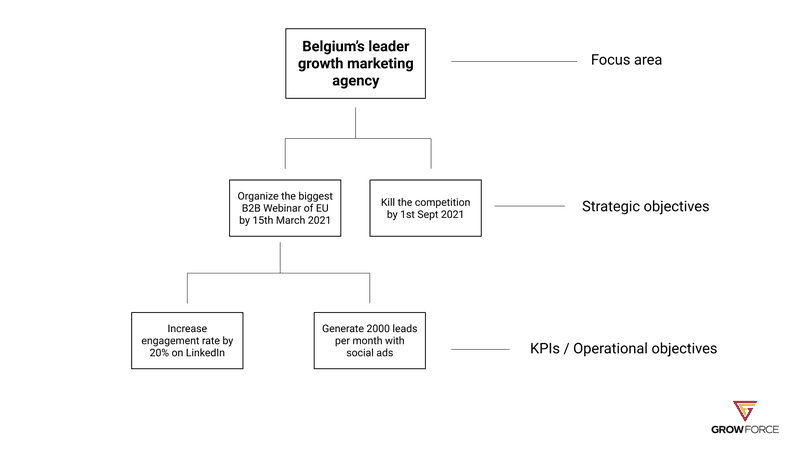
Strategic objectives are high-level goals that make your vision operational. They are not tactics or tasks. They are the 2 to 5 big bets per focus area that a department, team, or individual can own and be held to. Think of them as the goals people talk about in board meetings, not sprint planning.
They sit above KPIs and operational objectives. An operational objective might be "generate 2,000 leads per month via social ads." The strategic objective above it is "become the go-to lead generation engine for B2B SaaS in Belgium by Q3."
A good analogy: strategic objectives are the compass. KPIs and projects are the steps you take while following it. And unlike a mission statement, they have a due date. For more on how gap analysis connects to strategic objectives, see our breakdown of the gap analysis framework.
What is the purpose of strategic objectives?
There are three things strategic objectives actually do for an organisation.
1. They create alignment without micromanagement.
When an objective is clear and shared, people know what to prioritise. They stop asking "is this worth doing?" and start asking "does this move us toward the goal?" That question is far more productive, and it scales.
2. They remove uncertainty at the planning stage.
An end destination without a roadmap produces noise. Strategic objectives force the "when and how" conversation up front, before teams are mid-sprint and second-guessing direction. The planning overhead is front-loaded, not scattered across every Monday standup.
3. They anchor your operational objectives.
Operational objectives and KPIs only make sense in the context of something bigger. When a strategic objective is set, the operational steps beneath it almost write themselves. You know what to build, what to measure, and what to cut.
How many strategic objectives should you set?
Short answer: between 2 and 5 per focus area or department. The right number depends on the size of your organisation and the number of people who can genuinely own and lead an objective.
The mistake most teams make is setting too many. When everything is a priority, nothing is. You exhaust people without making meaningful progress on any single front. Set too few, and the ambition looks timid.
The diagnostic question to ask before finalising your list:
How many departments or focus areas do you have?
How many people can take genuine ownership of a goal (not just be assigned to it)?
Are any of these objectives duplicates dressed as different goals?
Run that check and you will land in the right range.
How to write a powerful strategic objective statement
The best strategic objectives share two qualities. They are understandable by someone with no industry context, and they are easy to remember. That means short sentences with no jargon.
The formula is simple: Action + Focus + Due Date.
Example: "Improve lead generation by 20% by 22 September 2025."
That single sentence tells a team what to do, what to improve, by how much, and by when. There is no ambiguity about whether it has been achieved.
A few things that kill a strategic objective statement: passive verbs ("ensure", "support"), no deadline, no measurable outcome, and sentences longer than 15 words. If you need to explain it in a follow-up sentence, rewrite it. For a practical example of how objectives connect to growth marketing vs growth hacking, the distinction matters when you are translating a strategic objective into a growth programme.
Once your strategic objective is written, the next step is building the sub-projects and KPIs beneath it. Our gap analysis framework is a practical way to map the distance between where you are and where the objective says you need to be.
Strategic objective examples across five departments
Good objectives are concrete and owned. Here are examples across the five departments we see most often when working with growth organisations.
Marketing
Increase brand awareness: grow organic visibility across key growth marketing channels by 30% before Q4.
Increase lead generation: build a content programme that fills the top of the sales pipeline with qualified B2B leads. See our breakdown of how to find customers online for tactical context.
Build thought leadership: become the most visible agency voice on LinkedIn thought leader ads and organic content in Belgium by end of year.
Decrease churn rate: reduce SaaS customer churn by 15% by improving onboarding experience and proactive support by Q2.
Growth
Invest in team capability: have every growth marketer certified in at least 2 new skills by H2. For context on what that skill stack looks like, see our post on building growth teams.
Scale experimentation: run at least 3 validated growth hacking experiments per quarter across acquisition, activation, and retention.
Finance
Diversify revenue streams: reduce dependency on any single client to below 20% of total revenue by Q3.
Create a growth budget: earmark 15% of annual revenue for growth investment and experimentation before the fiscal year starts.
IT
Improve data quality: ensure 95% of marketing data flows through clean, validated pipelines by end of Q2.
Improve security posture: achieve SOC 2 compliance and eliminate critical vulnerabilities identified in the annual audit. For context on how data quality affects data-driven marketing, this objective sits upstream of almost everything else.
HR
Improve the recruitment process: reduce average time-to-hire by 25% and cut first-90-day attrition by half by Q4.
Build culture intentionally: implement a structured onboarding programme and quarterly pulse surveys with an action plan for every low-score area before H2.
Customer service
Improve customer satisfaction: raise NPS from 32 to 50 by Q3 through faster response times and proactive issue resolution.
Invest in CRM technology: select and implement a new customer management tool that reduces average handle time by 20% before the end of the year.
What to do once your objectives are written
Writing the objectives is step one. The real work is building the operational projects and KPIs beneath each one. A quarterly strategic objective is not going to close itself. You need smaller, weekly or monthly steps that let you track whether you are on track or need to adjust.